

On-page SEO is the foundation of how people and search engines understand your website. It shapes how each page communicates intent, relevance, and value, which directly influences organic visibility and conversions. Aligning your content structure, metadata, internal links, and UX cues makes search engine optimization less about tricks and more about creating clarity. At Aayris Global, we help teams build this clarity systematically by connecting on-page optimization with the broader ecosystem of website SEO, technical SEO, and authority development. The result is a scalable layer of content and user experience that converts traffic into potential business opportunities. In this guide, you will learn how on-page SEO enhances performance across the entire search journey, how to align content to intent, and how to measure impact in a way that informs continuous improvement. Whether you are refining existing pages or building a new content engine, the principles below will help you prioritize and execute with confidence.
Table of Contents
Quick Summary
On-page SEO aligns your content and page experience to user intent so search engines can understand, rank, and reward your pages. It improves discoverability, relevance, and conversions by optimizing elements like titles, headings, internal linking, schemas, page copy, media, and UX signals. When paired with technical SEO and authority building, it becomes a compounding growth engine for website SEO. Use a structured framework to research queries, map intent, create high-quality pages, and continually test improvements.
- Focus on intent clarity, content depth, and crawl-friendly structure.
- Use consistent metadata and headings to communicate page themes.
- Build semantic internal links to distribute relevance and equity.
- Measure impact with search, engagement, and conversion metrics.
- Iterate using a documented playbook and editorial operations.
What Is On-Page SEO and Why It Matters
On-page SEO is the set of practices that help each page signal its topic, purpose, and value. It includes keyword and entity targeting, information architecture, headings, titles and descriptions, structured data, media optimization, internal links, and user experience patterns that drive engagement. The goal is to make it easy for search engines to parse your content and for users to accomplish their task.
Done well, on-page improvements tighten the connection among discovery, relevance, and conversion. They reduce ambiguity for crawlers, improve click-through rates with compelling snippets, and help users quickly validate that they are in the right place. At Aayris Global, we view on-page SEO as the vital link connecting technical SEO readiness with content strategy and conversion design.
For overview: The Complete Guide to Website SEO for Sustainable Organic Growth
How On-Page SEO Connects With Technical SEO and Off-Page Signals
On-page SEO does not operate in isolation. Technical SEO ensures your site can be discovered and crawled, while off-page signals like backlinks and brand mentions boost authority. On-page optimization translates that crawlability and authority into relevance and user satisfaction.
- Technical SEO establishes access: clean architecture, indexation control, performance, and security. On-page SEO then organizes and expresses meaning across this foundation.
- Off-page signals build trust. On-page SEO helps you earn and capitalize on that trust by delivering quality that encourages citations and shares.
- Website SEO is the orchestration of all three. When they align, each investment reinforces the others.
Practically, this means your keyword strategy, internal link map, and content templates should reference technical requirements like canonicalization, pagination, and schema patterns. It also means your editorial standards should be designed to earn links naturally by providing depth and originality.
Core Elements of On-Page Optimization
Search intent and topical focus
Every page should target a clear intent. Identify whether the query is informational, commercial, navigational, or transactional, then shape the structure and language accordingly. Use related entities and semantic variations to cover the topic with depth rather than repeating a single phrase.
Metadata that earns the click
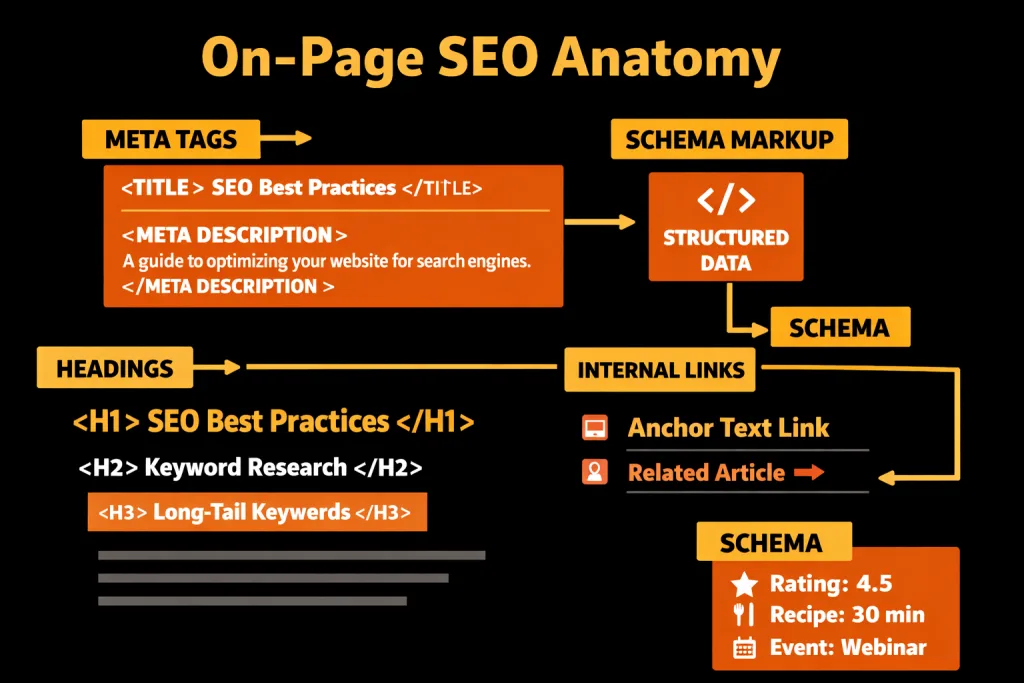
Titles and meta descriptions are your ad copy in the SERP. Make them specific, benefit-oriented, and consistent with on-page headings. Avoid keyword stuffing. Aim for clarity that reflects the primary value proposition of the page.
Headings that create a scannable outline
Headings should reflect a logical outline of the topic. Use H1 for the page promise and H2 to H4 for sections that map to subtopics and questions. Good headings improve both crawler comprehension and user engagement.
Body copy that solves the task
Build comprehensive, readable content. Combine narrative explanation with steps, examples, and checklists. Use short paragraphs, bullets, and descriptive anchor text for internal links to improve navigation and depth.
Internal linking and navigation
Internal links distribute authority and clarify relationships among topics. Link upwards to hubs and downwards to specific pages. Use descriptive anchors that match user expectations. Keep critical pages within a few clicks of your homepage.
Structured data and enhanced results
Schema markup helps search engines interpret content types like articles, products, FAQs, and how-to guides. It can enable rich results when appropriate. Prioritize accuracy and relevance. Validate with testing tools before deployment.
Media optimization
Images and video should support understanding. Use alt text that describes the asset’s purpose in context. Compress files and set appropriate dimensions to improve performance without sacrificing clarity.
UX signals and trust
Readable typography, accessible contrast, and clear calls to action reduce friction. Trust cues such as transparent authorship and updated dates help both users and algorithms evaluate credibility.
On-Page vs Technical vs Off-Page SEO: What Each Controls
The categories of website SEO often overlap, but each has distinct responsibilities. The table below summarizes the primary control areas to help teams delegate and prioritize effectively.
| SEO Area | Main Responsibilities | Primary Outcomes | Common Tools |
|---|---|---|---|
| On-Page SEO | Intent targeting, metadata, headings, copy, internal links, schema, media | Relevance, engagement, conversions, SERP click-through | Keyword tools, content editors, schema testers |
| Technical SEO | Crawlability, indexation, speed, canonicalization, sitemaps, security | Discoverability, stability, scalable site health | Crawlers, log analyzers, performance testers |
| Off-Page | Backlinks, digital PR, brand mentions, partnerships | Authority, trust, ranking potential | Link analysis, media monitoring |
Use this separation to prevent gaps. For example, a page may be authoritative and crawlable but still underperform if its headings do not match the query pattern or if the meta description fails to earn clicks.
Content Engineering for Search Intent Alignment
High-performing pages translate intent into information architecture. Start by mapping questions and tasks to sections. If the query is how-to, lead with steps and add context later. If it is a comparison, emphasize criteria and differences before deep dives. Use patterns that match expectations.
- Entity coverage: Expand beyond a single keyword to cover related concepts, synonyms, and attributes. This signals topical completeness.
- Answer density: Place concise answers near the top for quick validation, then provide depth for engaged readers.
- Evidence and clarity: Use examples, definitions, and process explanations. Where third-party support is needed, add citations like [CITE: source].
- Conversion alignment: Pair educational content with contextual CTAs that help users take the next step without interrupting reading flow.
At Aayris Global, we integrate search intent into editorial templates so writers and editors naturally produce content that satisfies both algorithms and people.
Measurement and Diagnostics: How to Evaluate Impact
You cannot improve what you cannot measure. Track a layered metric set that spans visibility, engagement, and business outcomes. Avoid over-reliance on a single KPI. Most teams use a mix of search console data, analytics, and qualitative review to guide iteration.
Visibility and relevance metrics
- Impressions and average position for primary and secondary queries
- Click-through rate by page and query
- Rich result eligibility and coverage when schema is in use
Engagement and experience metrics
- Time on page, scroll depth, and return-to-SERP behavior
- Navigation paths influenced by internal links
- Core Web Vitals and page responsiveness
Business outcomes
- Micro conversions like downloads and demo clicks
- Macro conversions like qualified leads and purchases
- Assisted conversions from content touchpoints
Use change logs to tie outcomes to specific on-page releases. When results are ambiguous, run controlled tests, such as metadata experiments and alternative heading structures. Where data is incomplete, add a note such as [VERIFY DATA: channel attribution detail].
Common Pitfalls to Avoid
Many teams work hard on content but miss basic on-page signals. Watch for these issues and create checklists to prevent regressions.
- Weak title semantics: Titles that lack specificity or misalign with the H1 create mixed signals and lower click-through.
- Over-optimized copy: Repeating a keyword reduces readability and can dilute intent. Prefer natural language anchored to entities and questions.
- Orphan pages: Valuable content without internal links rarely reaches its potential. Always connect new pages to relevant hubs.
- Thin templates: Using the same layout for every intent type limits relevance. Adjust sections based on task models.
- Unvalidated schema: Inaccurate structured data can confuse crawlers. Validate and monitor for errors after deployment.
- Ignoring SERP format: Adjust your presentation to align with user expectations if how-tos, comparisons, or visual packs dominate the results.
A Practical On-Page SEO Framework You Can Apply
The following step-by-step framework helps teams operationalize on-page SEO at scale. It works for new builds and iterative optimization.
Step 1: Define search themes and intents
Group queries by topic and intent rather than chasing individual keywords. Map each theme to a page or cluster. Confirm SERP patterns to validate presentation format.
Step 2: Architect the page
Outline headings that reflect user questions and tasks. Place quick answers near the top and depth below. Reserve space for trust elements like author bios and update notes.
Step 3: Draft for clarity and completeness
Write to solve the task with minimal friction. Use examples, lists, and visuals to improve comprehension. Keep paragraphs concise and active.
Step 4: Optimize metadata and internal links
Create specific, benefit-oriented titles and descriptions. Add internal links with descriptive anchors to hubs and related pages to strengthen topical relationships.
Step 5: Add structured data and media
Apply relevant schema types and validate. Optimize images and video for speed and accessibility. Provide alt text that reflects function and meaning.
Step 6: Publish, measure, iterate
Ship improvements in manageable batches. Monitor search and engagement metrics, then test iterative refinements. Document outcomes to build a playbook.
For broader context on how this framework connects to your sitewide strategy, see our guide to website SEO for sustainable growth.
Implementation Roadmap and Governance
On-page SEO succeeds when content, product, and engineering collaborate. Build a lightweight governance model that clarifies ownership and avoids bottlenecks.
- Roles and responsibilities: Define who researches, writes, reviews, implements markup, and ships updates.
- Templates and checklists: Standardize page types and QA steps. Include metadata, a heading map, an internal link plan, a schema, and performance checks.
- Release cadence: Batch improvements to streamline measurement. Keep a change log to attribute impact.
- Feedback loops: Use editorial retrospectives and analytics reviews to refine standards and share wins.
Aayris Global helps organizations transform isolated tasks into a connected growth system that blends technical SEO, on-page optimization, and performance marketing. This reduces rework, speeds iteration, and compounds results across channels.
FAQ
On-page SEO focuses on content, metadata, headings, internal links, schema, and UX that communicate relevance. Technical SEO addresses crawlability, indexation, performance, and site architecture that enable discoverability and scale.
Timelines vary based on crawl frequency, competition, and site authority. Teams usually monitor early indicators like improved click-through and engagement while waiting for ranking shifts.
No. Prioritize by opportunity and impact. Start with high-value pages or templates and roll out changes in batches to isolate effects and learn quickly.
Target a topic and intent rather than a fixed keyword count. Cover primary and secondary queries with natural language and related entities. Avoid over-optimization.
Structured data is not required but often helps search engines interpret content types and can enable rich results. Implement only when it accurately reflects the page.
Use a combination of keyword research tools, crawler audits, schema validators, and analytics platforms. Select tools that fit your workflow and technical stack.
Internal links distribute relevance and authority, helping search engines understand relationships among topics. Descriptive anchors and logical pathways improve both crawling and user navigation.
Yes. Clear messaging, structured content, and contextual CTAs help users complete tasks, which can increase conversions. Test placement and copy to optimize outcomes.
Updating content to reflect current information and user needs can improve relevance and trust. Focus on substantive updates that add value rather than cosmetic edits.
Conclusion
On-page SEO turns your website into a clear, useful, and searchable resource. By aligning each page to user intent and reinforcing it with precise metadata, structured headings, schema, and internal links, you improve both visibility and conversion. When integrated with technical SEO and thoughtful authority building, on-page optimization becomes a reliable driver of long-term performance across website SEO.
If you want a partner that treats SEO as a connected growth system rather than a set of one-off tasks, Aayris Global can help. We combine data-driven strategy, content engineering, and performance marketing to strengthen your digital foundation and accelerate results. Contact Aayris Global for expert assistance.